Magic mushrooms, also known as psilocybin mushrooms, grow in many parts of the world. They aren’t limited to just one country or type of environment. In fact, scientists have found them on every continent except Antarctica. These mushrooms grow in nature and come in many shapes and sizes, depending on the climate, season, and where exactly they’re found.
If you’re curious about how they grow or what makes them special, this article will walk you through the basics, from the habitats they love to how they can be safely recognized in the wild.
Magic mushrooms are more common than you might think. But they don’t grow everywhere in equal numbers. Some places are known for having more species than others.
Mexico and Central America are considered the world’s top spots for mushroom diversity. Mexico alone has more than 50 species of magic mushrooms. Many of these, like Psilocybe mexicana, have been used by Indigenous groups for hundreds or even thousands of years.
In North America, the Pacific Northwest (including parts of Oregon, Washington, British Columbia, and Northern California) is known for its cool, wet climate. This area is great for wood-loving mushrooms like Psilocybe cyanescens and Psilocybe azurescens.
Europe, especially the UK, Germany, and Scandinavian countries, is home to a tiny but famous species called Psilocybe semilanceata, also known as the Liberty Cap. These mushrooms grow in grassy fields and are common in the fall.
In tropical areas like Brazil, Thailand, and Bali, you’ll find Psilocybe cubensis, also known as the “gold cap.” It’s one of the most well-known mushrooms of this kind, especially in places with warm temperatures and regular rain.
Australia has its own species, too. A good example is Psilocybe subaeruginosa, which grows in forests and city parks along the coast.
Most magic mushrooms feed on decaying plants and other organic matter. Scientists call this kind of eating “saprotrophic.” Depending on what they eat and where they grow, magic mushrooms usually fall into three habitat types:
Yes, some mushrooms actually grow from manure, especially from animals like cows or horses. These are called “coprophilous” mushrooms. One of the most common types here is Psilocybe cubensis, which is often found in warm, wet fields where livestock graze. Another is Panaeolus cyanescens, sometimes called “Blue Meanies.”
Why do they grow in dung? Manure holds a lot of nitrogen and water, two things mushrooms need. These types are often spotted after heavy rain, when humidity is high.
These mushrooms grow in soil that’s rich in decaying grass. They don’t grow directly on dung, but you’ll often find them in fields where animals graze. A good example is Psilocybe semilanceata, the Liberty Cap. These mushrooms are tiny, bell-shaped, and love cool, damp grasslands like meadows, sheep fields, or even golf courses.
Look for them in the fall, especially in places that aren’t disturbed by plowing or heavy foot traffic.
This group of mushrooms grows on dead wood, like fallen logs, branches, or even wood chips used in landscaping. Species like Psilocybe cyanescens (Wavy Caps) and Psilocybe azurescens (Flying Saucers) fall into this group.
Wood-lovers can often be found on the edge of forests or near rivers. Interestingly, they’ve also been found in city parks and gardens, especially in places that use wood mulch. These species are strong decomposers and break down tough plant material like lignin and cellulose in wood.
Even if mushrooms are present in an area, they only grow (or “fruit”) under certain conditions. Here are the main things they need:
If all of these conditions are met, mushrooms may pop up almost overnight.
Here are five of the most commonly found magic mushrooms in the wild, each with its own habitat and look.
Many mushrooms look alike, and not all are safe. Some are toxic, even deadly. So knowing how to identify them is very important.
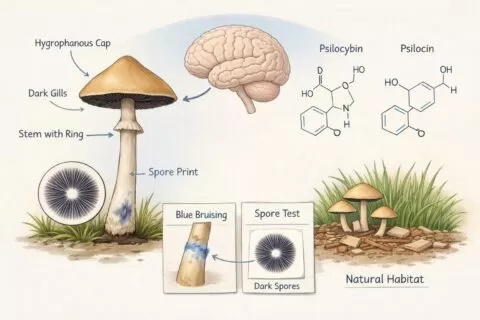
Here are three clues that mycologists (mushroom scientists) use:
But even with these clues, mushroom identification is tricky. One toxic mushroom, Galerina marginata, looks very similar to some magic mushrooms and can cause liver failure if eaten. That’s why people are strongly advised not to eat any wild mushrooms unless identified with absolute certainty by an expert.
Magic mushrooms are part of the natural world and have a long history. They grow in many places, from cow fields in the tropics to forest edges in the Pacific Northwest. But while it can be fascinating to learn about them, identifying mushrooms in the wild takes real skill. Many safe-looking mushrooms are dangerous, and many dangerous mushrooms look harmless.
Learning where and how mushrooms grow is a great first step. But as with anything in nature, it’s best to approach with respect, caution, and curiosity, not assumptions.

Are You 18 Or Over?
By clicking 'Continue', you confirm that you are over 18 years old. By using this website, you agree to our terms of service.