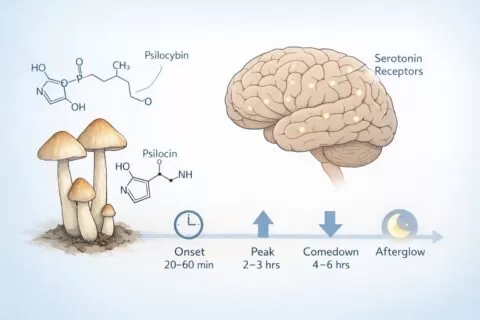
Magic mushrooms, also known as psilocybin mushrooms, are a type of fungi that grow naturally in many parts of the world. They contain a chemical called psilocybin, which can affect the way people think and feel. Over the past few years, interest in these mushrooms has grown, not just for their effects, but also for their place in nature, history, and science.
So where do these mushrooms grow? And how can people find them, legally and safely? This guide breaks it all down in simple terms.
Magic mushrooms are not rare. In fact, they grow on every continent except Antarctica. But they don’t grow just anywhere; they have favorite places, depending on the species.
Some of the most common species, like Psilocybe cubensis, choose to grow naturally where cows or other large animals graze. These mushrooms are called coprophilous, which means they grow in or near animal dung. You’ll usually find them in tropical or subtropical climates, think of warm places with lots of rain and grasslands.
In cooler places like the Pacific Northwest or urban gardens, some species have adapted to live in man-made environments. Psilocybe cyanescens and Psilocybe allenii love wood chips, especially those found in landscaping, park trails, or flower beds. This means people sometimes find them growing near schools, libraries, or in city parks.
Psilocybe semilanceata, also called Liberty Caps, is one of the most widely found species in the world. It prefers grassy areas with acidic soil, such as sheep or cow pastures. But unlike P. cubensis, it doesn’t grow directly on dung.
Some mushrooms grow best in places where the earth has been moved or damaged. These can include riverbanks, landslides, forest paths, or construction zones. When soil gets disturbed, it creates a new opportunity for mushrooms to take hold.
While magic mushrooms grow in many places, they even grow in the wild. Some areas are especially well-known for the number and variety of species that appear there.
Oregon, Washington, and British Columbia are famous for their moist climate and cool temperatures. This is where you’ll find species like Psilocybe cyanescens and Psilocybe azurescens. P. azurescens is considered one of the strongest known species.
This region has a long history with psilocybin mushrooms. Indigenous communities in Mexico have used them in ceremonial practices for centuries. Species like P. cubensis and P. mexicana grow well in the warm, humid climate.
In countries like the UK, Ireland, and the Netherlands, P. semilanceata is common in the fall. From September to November, Liberty Caps often appear in damp meadows and pastures.
In the Southern Hemisphere, species like P. subaeruginosa grow in eucalyptus forests and even in urban mulch beds.
Countries like Thailand and Cambodia have tropical climates that are perfect for P. cubensis. These mushrooms tend to grow in the lowlands, often near livestock farms.
In some parts of the world, the laws around magic mushrooms are starting to change. People are beginning to access them in legal settings, either for medical use or personal exploration under supervision.
In Jamaica and The Bahamas, psilocybin mushrooms are legal to grow, sell, and consume. They’re often sold in cafes or shops. In the Netherlands, a special part of the mushroom called a truffle (which grows underground) is legal and sold in stores called “smart shops.”
In places like Seattle, Denver, and Detroit, personal use and possession of psilocybin have been decriminalized. This means people are unlikely to be arrested for small amounts. Some states, like Oregon and Colorado, have taken things further by creating licensed systems for supervised use.
In Australia, authorized psychiatrists can prescribe psilocybin for certain mental health conditions. In 2026, the Czech Republic joined a small number of countries that allow medical prescriptions for patients with treatment-resistant depression.
In some countries, psilocybin is allowed in religious settings. In Brazil, for example, it can be used in traditional ceremonies protected by religious freedom laws.
You might be surprised to learn that some magic mushrooms grow in very ordinary places. People have found them:
This has made urban foraging more popular, especially in places where possession is decriminalized. But foraging comes with big risks, mainly because of mushroom misidentification.
Knowing where mushrooms grow is one thing. Knowing how to identify them safely is another. Even experienced foragers sometimes make mistakes, and those mistakes can be deadly.
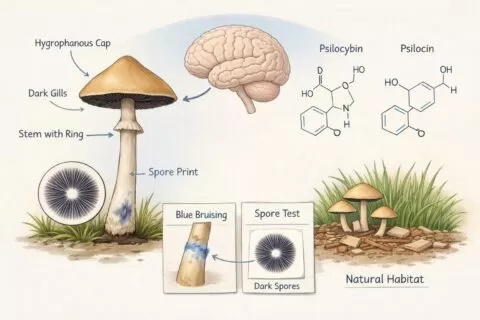
Mushroom experts often take a spore print to help identify a species. This involves placing the cap of the mushroom on a white piece of paper and waiting for the spores to fall. Psilocybe species usually leave a dark purple-brown to black spore print.
When most psilocybin mushrooms are handled or broken, they develop a bluish color at the damage point. This is caused by a chemical reaction in the mushroom and is one of the signs experts use to identify it.
The problem is that some deadly mushrooms look very similar to psilocybin species. For example, Galerina marginata, also called the Funeral Bell, can be deadly even in small amounts. It contains a poison called amatoxin, which damages the liver and can be fatal without fast treatment.
Because of this, mushroom foraging is never recommended for beginners. If someone is interested in learning more, it’s best to connect with a mycology club, attend a guided foray, or study under someone with professional training.
Magic mushrooms grow in many parts of the world, on farms, in forests, even in cities. Their natural habitats range from cow pastures to garden mulch. Some regions, like the Pacific Northwest, Mexico, and parts of Europe, are known for specific species and ideal conditions.
In recent years, access has changed, too. In places like the Netherlands, Jamaica, and parts of the U.S., there are now legal ways for people to find or use psilocybin mushrooms under controlled settings.
But with that comes responsibility. Foraging can be dangerous without training, and laws still vary widely. Anyone curious about magic mushrooms should focus on learning, not rushing.
Understanding where they grow is just one part of the puzzle. The rest involves patience, science, and respect for the law, for nature, and for safety.

Are You 18 Or Over?
By clicking 'Continue', you confirm that you are over 18 years old. By using this website, you agree to our terms of service.