Magic mushrooms may look like regular mushrooms to the untrained eye, but their smell tells a more complex story. Whether you’re simply curious, researching for educational purposes, or learning how to identify different fungi, understanding how these mushrooms smell can be helpful. Their scent isn’t just one thing; it changes based on species, how fresh they are, and even how they’ve been stored.
Let’s break it down in a way that’s easy to follow.
Most magic mushrooms, especially those in the Psilocybe group, are known for one special kind of smell: farinaceous. That’s a fancy word used by mushroom experts, but here’s what it means in plain terms.
A farinaceous smell is kind of like:
It’s a soft, floury scent that sometimes surprises people who expect something strong or bad. But this smell is actually quite mild and even pleasant to some.
Underneath this, there’s often an earthy, damp smell, like soil after a rainstorm or the scent of a garden after digging in fresh dirt. That’s because mushrooms grow in rich, moist places like forest floors, compost, or decaying wood. A compound called 1-octen-3-ol is mostly responsible for this earthy aroma. It’s common in many mushrooms and adds that “forest” smell people often notice.
The way magic mushrooms smell also depends a lot on whether they’re fresh, dried, or even old. Here’s how the scent changes at each stage:
Yes. While most Psilocybe mushrooms have that typical flour-and-earth smell, some kinds have their own twist on it. Let’s look at a few popular types:
This is the most well-known magic mushroom. It usually has a neutral scent, mildly earthy and farinaceous. Unless it’s going bad, it won’t smell very strong.
This one is known for having a much stronger farinaceous smell. Some say it smells like green beans or cornmeal. People who’ve handled them often say the scent is more noticeable than other types.
These are smaller and found in grasslands. They have a much fainter smell, sometimes described as grassy or herbal. Because of their size and where they grow, their scent doesn’t stand out as much.
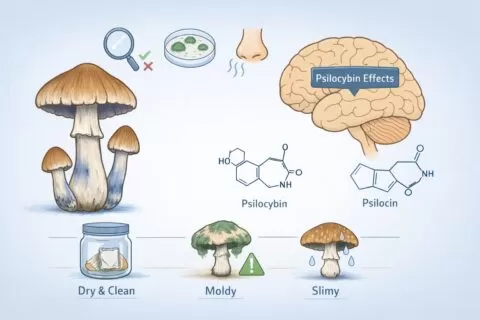
Smell isn’t just about identifying a mushroom or it losing potency over time; it can also help you avoid a dangerous one. If a mushroom smells “wrong,” it might be contaminated or decaying. Here are some red flags to be aware of:
In all these cases, the scent is your body’s way of warning you. A healthy mushroom should never make your nose curl.
If you’re growing mushrooms at home under legal and licensed conditions, you’ll also be familiar with mycelium, the web-like root system of the mushroom. It’s usually white and spreads through the growing medium (like a jar or block).
This is important because smell is one of the first and most reliable signs of contamination. If the mycelium smells off, it probably is off.
Knowing what magic mushrooms are supposed to smell like helps people stay informed and safe. Whether you’re reading for educational reasons, learning how mushrooms grow, or researching their biology, smell can give you a lot of clues.
It helps you:
Even if you never touch a mushroom yourself, being able to describe their smell accurately can be useful. For example, in scientific studies, trained mushroom foragers often use scent as one of their main tools. It’s not just about looks.
Magic mushrooms have a smell that’s more complex than you might expect. From the soft scent of raw dough to the deep, earthy smell of forest soil, their aroma is shaped by species, age, and how they’re stored.
Most have a mild, floury scent. Some are more vegetal or grassy. And when things go bad, your nose will tell you, fast. Knowing these differences is a smart and simple way to stay informed.
So the next time you hear someone ask, “What do magic mushrooms smell like?”, you’ll know the answer goes beyond just one word. It’s part flour, part forest, and always worth paying attention to.

Are You 18 Or Over?
By clicking 'Continue', you confirm that you are over 18 years old. By using this website, you agree to our terms of service.