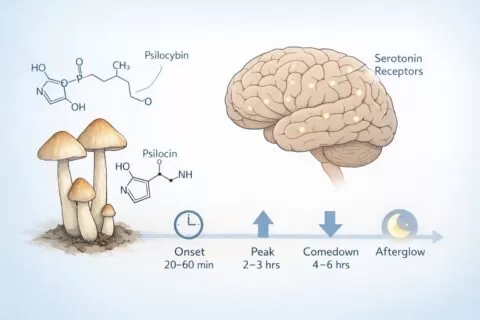
Mushrooms come in all shapes, colors, and sizes. Some are safe to eat. Some are deadly. A few contain a chemical called psilocybin, which causes great changes in how a person sees, thinks, and feels. These are often called magic mushrooms.
Telling the difference between regular mushrooms, magic mushrooms, and poisonous ones is very hard. Some deadly mushrooms look almost the same as magic ones. That’s why only trained mushroom experts, called mycologists, should ever try to identify them in the wild.
This guide will help you understand how certain mushrooms are identified as “magic.” It’s for learning only, not for use. Never eat a mushroom unless it comes from a safe, trusted source.
Magic mushrooms are a group of fungi that contain psilocybin and psilocin. These are natural chemicals that affect the brain. They are found in many species of mushrooms that grow in forests, grasslands, or even cow pastures. The most common types belong to a group called Psilocybe, but others can also contain these chemicals.
There are a few signs that help mycologists figure out if a mushroom might be one of the magic types. But remember, these signs are not 100% proof, and mistakes can be deadly.
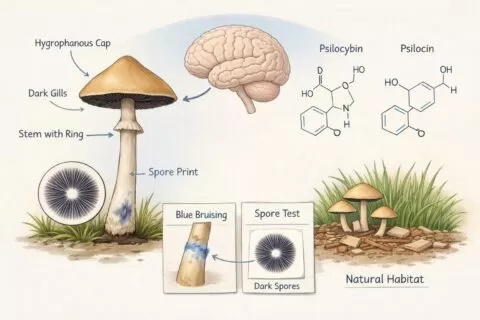
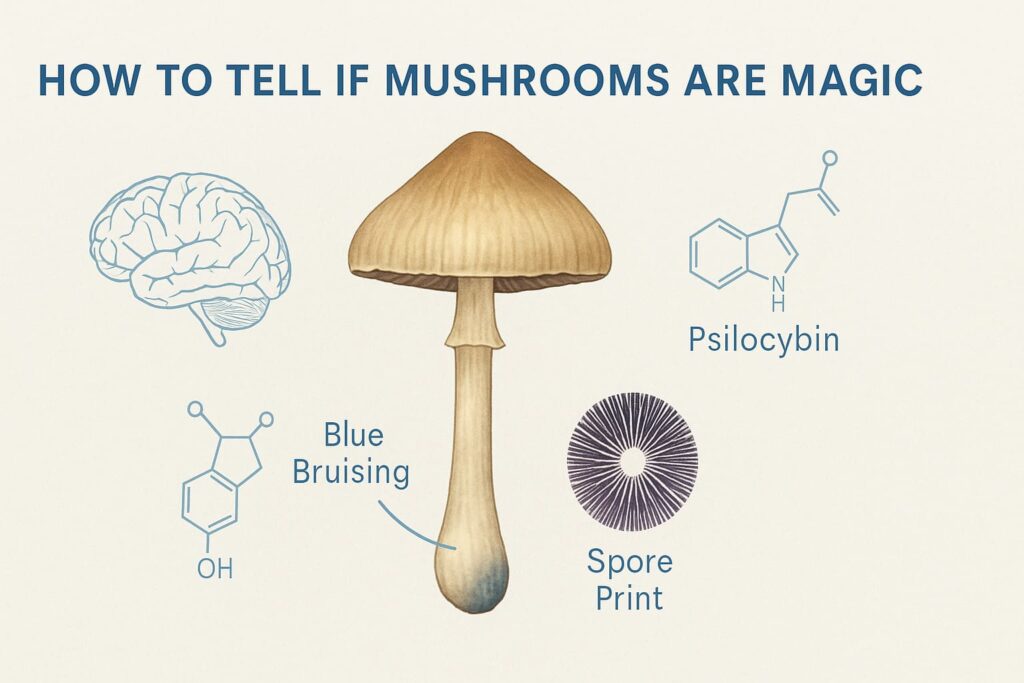
One of the best-known signs is blue bruising. This means the mushroom turns blue when it is touched, bent, or broken. The color change is a reaction between oxygen and psilocin in the mushroom. This can happen on the cap or the stem. However, some toxic mushrooms can also turn blue, and some magic ones don’t show this effect clearly. So blue bruising helps, but it’s not a guarantee.
The spore print is the color of the powdery spores that fall from the mushroom cap. To make one, place the cap face-down on a white and black sheet of paper, then cover it with a bowl. After a few hours, you’ll see a pattern left behind. Magic mushrooms usually leave a dark purple-brown or black-brown print. Deadly mushrooms often leave rust-brown or orange prints.
To tell mushrooms apart, experts look at four main parts: the cap, the gills, the stem, and the spore print.
The cap can be smooth and sticky when wet. It may change color as it dries. For example:
The gills are the thin lines under the cap where spores come out. They may start light but get darker as the spores mature. In magic mushrooms, the gills often turn a dark purplish color.
Stems can be thin or thick. Some magic mushrooms have a ring, called an annulus, around the top of the stem. This ring is left over from when the cap was still developing. In P. cubensis, this ring is often visible, but in P. semilanceata, it usually isn’t.
As mentioned above, the spore print is one of the most important steps in identification. Magic mushrooms usually leave a dark purple-brown or black-brown print.
Knowing where a mushroom grows can give helpful clues.
One of the biggest risks is mistaking a toxic mushroom for a magic one. Some deadly mushrooms look very similar and grow in the same places.
Even a photo is not enough to make a clear ID. Two mushrooms can look almost the same and be totally different in their effects. Eating the wrong one can lead to serious illness or death.
Figuring out whether a mushroom is “magic” takes more than just one test. Experts use many clues: the shape, the color, how it bruises, where it grows, and what kind of spore print it leaves. But even with all these steps, the risk of mistakes is high.
Unless a mushroom is clearly labeled and sold by a trusted source, it is never safe to eat one based on looks alone. Some of the most dangerous mushrooms look harmless, and some of the safest ones look scary.
So, how can you really tell if a mushroom is magic? The truth is, unless you’re a trained expert, you can’t.