Magic mushrooms have gained attention for their unique chemical properties, especially in research and wellness communities. But identifying them in the wild is not easy. Many mushrooms can look similar, even deadly ones. So if you’re ever curious about how to spot magic mushrooms, knowing what to look for (and what to avoid) is key. This guide will help you understand the basics of mushroom identification, focusing on common traits, safe habits, and dangerous lookalikes.
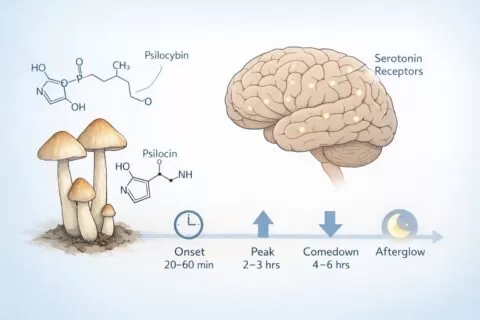
The term “magic mushrooms” usually refers to fungi in the Psilocybe genus. These mushrooms contain natural chemicals like psilocybin and psilocin, which affect the brain. While some U.S. states and parts of Canada are exploring regulated therapeutic use, these substances are still illegal in many places and are classified as controlled substances at the federal level.
Still, learning about how to spot and identify these mushrooms can be valuable from a scientific, educational, or ecological standpoint. Mushroom identification also plays a role in public safety, especially since some toxic species look very similar to magic mushrooms.
Mushrooms may all seem similar at a glance, but if you know where to look, you’ll see that each part tells a story. Here are the four parts you should always check when identifying any mushroom, especially a potential magic mushroom.
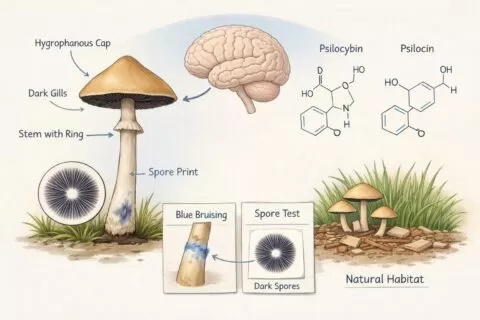
This is the top part of the mushroom. In many magic mushrooms, the cap starts out cone-shaped or like a small bell and then flattens as the mushroom grows. The cap is often “hygrophanous,” meaning it changes color when it gets wet or dries out. For example, a cap might look dark brown after rain but turn pale tan once dry.
Under the cap, you’ll find thin, blade-like ridges called gills. In most Psilocybe species, these are closely packed together. As the mushroom matures, the gills usually turn a dark purple-brown to nearly black due to the spores.
The stem is often slender and fibrous. Some species have a ring around the stem, called an annulus, which is left over from a partial veil that covered the gills when the mushroom was younger. This feature isn’t always present, but it can be helpful for identification.
This is one of the most important tools for identifying mushrooms. To take a spore print, place the cap on white paper or aluminum foil and leave it for a few hours. If the spores are dark purple-brown (almost black), it could be a Psilocybe mushroom. If they’re rusty orange or white, it’s likely not.
One well-known trait of many magic mushrooms is that they bruise blue when touched or damaged. This color change is caused by a chemical reaction when psilocin (one of the active compounds) comes into contact with air.
However, not all mushrooms that bruise blue are magic, and not all magic mushrooms bruise blue right away. For example, some poisonous mushrooms like certain Boletus species also bruise blue, but are not safe. So treat this test as a clue, not a guarantee.
Magic mushrooms don’t grow just anywhere. They prefer certain environments, and knowing their “neighborhoods” can help in identification. Here are three of the most commonly known Psilocybe species and where they tend to appear:
This species is often found in humid, subtropical areas, especially in cow or horse manure. It’s one of the largest species, with a golden cap and thick white stem. It bruises blue quite clearly.
These small mushrooms usually grow in grassy meadows or pastures, especially where animals have grazed. They have a little pointed “nipple” at the top and a slippery, jelly-like skin when wet.
These grow on woodchips, garden mulch, or in landscaping beds. Their caps have a caramel color and wavy edges. They’re known to be quite strong and also show noticeable blue bruising.
Each species has its own season and region, so not every magic mushroom grows everywhere. Even if a mushroom fits some traits, it must match all of them, including habitat, before it can be considered a possible Psilocybe species.
Some mushrooms that look like magic mushrooms are actually deadly. This is the most important reason why identification must be done carefully and never rushed.
This is one of the most dangerous lookalikes. It grows on wood, like Psilocybe cyanescens, and has a brownish color. However, it contains amatoxins, which can cause liver failure and death. A key difference is in the spore print. Galerina has rusty-orange spores, while magic mushrooms have dark purplish spores.
Some of these mushrooms look similar to Psilocybe semilanceata, especially when young. But they contain muscarine, a toxin that can cause sweating, slow heart rate, and even respiratory failure. These mushrooms often smell unpleasant, like rotting potatoes or fish.
Because of these risks, it’s never enough to just go by color or shape. You need to check all identifying features, especially the spore print, to avoid dangerous mistakes.
If you’re studying mushrooms in nature, follow these three golden rules to stay safe:
No mushroom should be identified without a spore print. It’s one of the only ways to truly know what you’re looking at. If the spore print isn’t dark purplish-brown, it’s not a magic mushroom.
Many Psilocybe mushrooms have a thin, skin-like layer on the cap that can be peeled off. This is known as a “gelatinous pellicle.” It’s another helpful trait, but not always easy to see unless the cap is fresh and wet.
If a mushroom doesn’t match every single identifying feature, walk away. Even small mistakes can lead to big consequences. If you’re not 100% sure, it’s not worth the risk.
Spotting a magic mushroom takes more than a quick glance. It’s about knowing the details, the cap shape, the gills, the spores, the habitat, and even how the mushroom bruises. But it’s also about knowing what not to pick. Toxic lookalikes can fool even experienced foragers, which is why safe identification isn’t just a skill, it’s a responsibility.