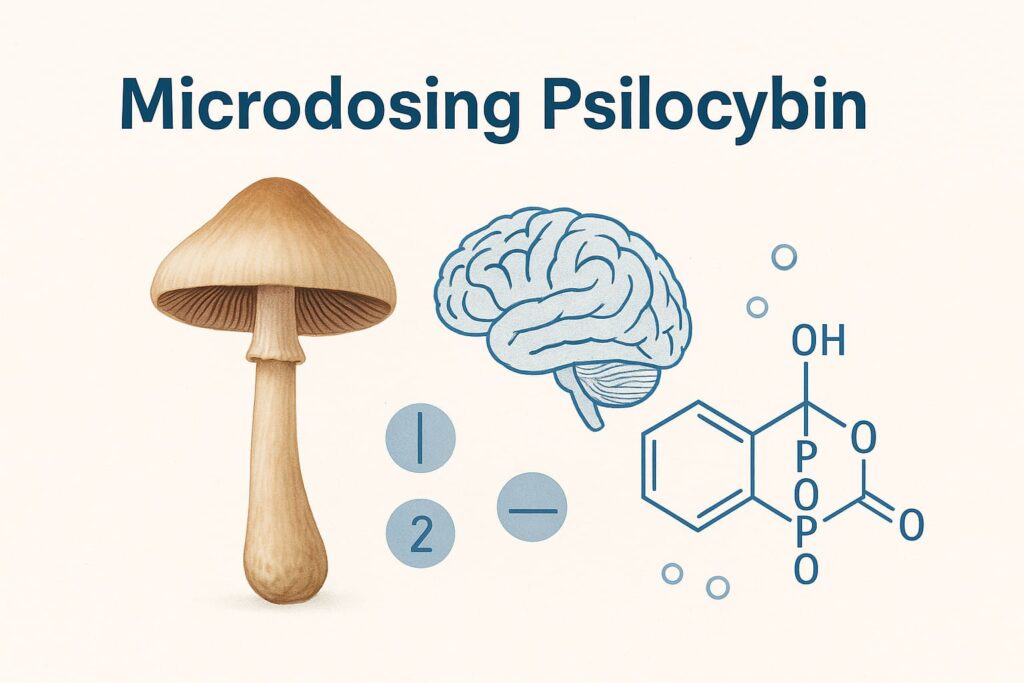
Microdosing is a term people use when they talk about taking very small amounts of a psychedelic substance. These amounts are normally too small to cause hallucinations or a “trip.” Instead, the idea is that the dose is so low that a person shouldn’t feel high or impaired at all.
Scientists describe microdosing as sub-perceptual exposure to a substance. That means the dose is below the level where the brain produces obvious psychedelic effects. In research settings, scientists study microdosing to understand how tiny amounts of psilocybin may affect the brain, behavior, or mood under controlled conditions.
Even though microdosing is talked about a lot online, it’s still a new area of science. Most studies so far are small and early. Many results are mixed, and researchers continue to point out that we need more data before drawing strong conclusions.
Researchers who collect surveys and run early pilot studies have found that people report several reasons for wanting to microdose. These reasons come from self-reported experiences, not proven medical results. Common themes include:
Some study participants say they feel calmer or more emotionally steady on microdosing days. Researchers stress that these are personal reports and not medical evidence.
A few small studies have explored whether microdosing may help people think more creatively or stay more focused. Some participants say they notice benefits, while others report no change at all.
Some people say they feel more energized or motivated. But again, these effects may be heavily influenced by expectations and the placebo effect.
Many people say microdosing helps them feel more present or aware during the day. Scientists are still studying why this might happen and whether it holds up in controlled conditions.
Almost all researchers agree that placebo effects can be very strong, and this makes it hard to separate real effects from expectations.
Research on microdosing is still growing. Scientists have run surveys, small clinical trials, and placebo-controlled studies. The results give a mixed but interesting picture.
Studies show that some participants report feeling better, more focused, or more creative. Others experience no change.
In several studies, participants who believed they took psilocybin, even when they actually took a placebo, reported the same positive effects. This tells researchers that expectations have a powerful influence.
Even very small exposures may affect mood. Some studies note that people with anxiety, trauma histories, or certain mental health conditions may be more vulnerable to negative reactions.
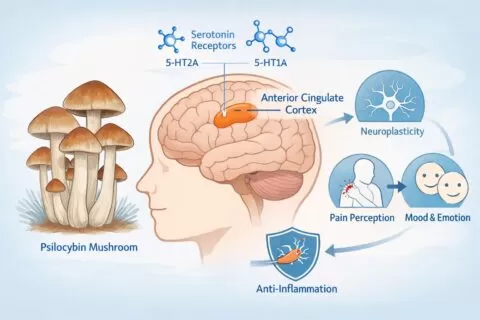
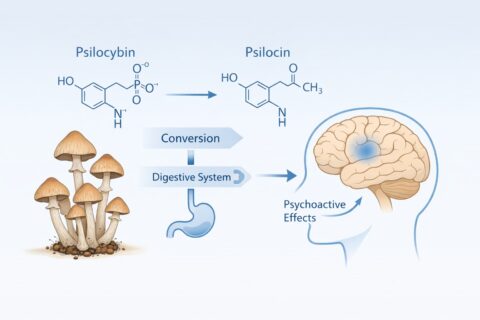
Psilocybin interacts with serotonin receptors. Because of this, scientists worry about possible interactions with mental-health medications, especially antidepressants.
In unregulated spaces, dosing and purity can vary widely. This makes real-world microdosing unpredictable and potentially unsafe.
Even though microdosing involves small amounts, it still carries real risks, especially outside supervised studies.
Some people report anxiety, restlessness, or emotional discomfort. These reactions may be stronger for people with certain personal or family mental-health histories.
Possible effects mentioned in studies include nausea, headaches, or upset stomach.
Some participants in microdosing studies report sleep problems, especially if psilocybin exposure happens later in the day.
Psilocybin tolerance builds quickly. This means the brain may adapt fast, reducing effects or encouraging higher amounts, something researchers strongly warn against.
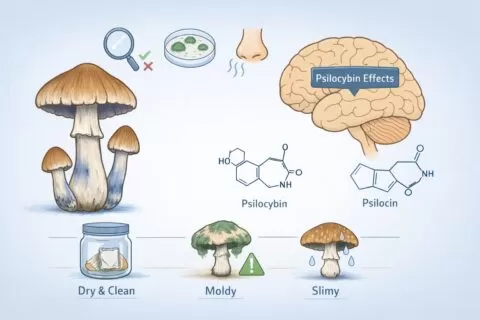
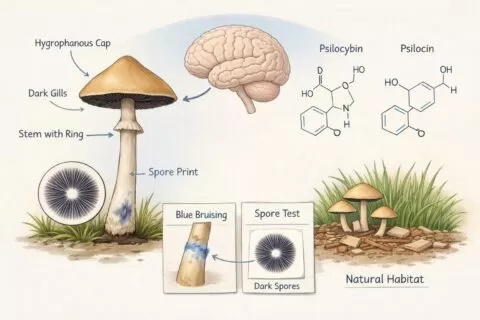
Outside regulated research settings, the risk of mistaking a toxic mushroom for a psilocybin species is real. There is also a risk of contamination or uneven potency in unregulated products.
In approved studies, experts follow strict safety rules that protect participants:
These safeguards are required because psilocybin is a controlled substance with psychoactive effects, even at low exposures.
This structured environment is very different from real-world use, which has none of these protections.
Even though microdosing is widely discussed, the science is still developing. Public-health experts highlight several key reminders:
Learning about microdosing can help consumers stay informed, avoid misinformation, and understand the legal consequences and scientific limitations that exist today.
Microdosing is an interesting and widely discussed topic, especially in conversations about mental health and well-being. Early research shows possible benefits for some people, while also revealing strong placebo effects and real risks. Scientists continue to study how psilocybin affects the brain at very small exposures, but many questions remain.
Because psilocybin is illegal under U.S. federal law and Canada’s national law, and because quality, purity, and safety cannot be guaranteed outside of controlled research settings, microdosing should not be attempted casually or without proper legal and medical guidance.
As research grows and laws evolve, the scientific community will continue working to understand the real effects of microdosing, the risks involved, and whether it has a safe place in regulated mental-health treatment in the future.